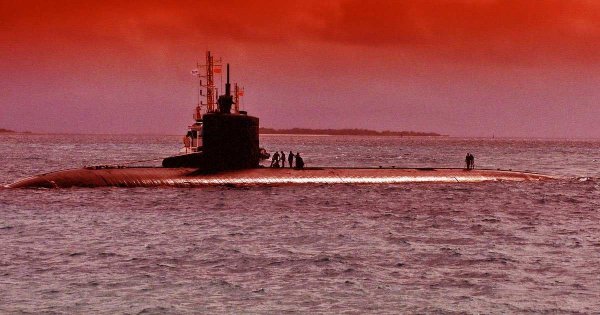
The U.S. Navy remains in the dark about what its nuclear-powered attack submarine struck in the South China Sea earlier this month, even as the vessel undergoes repairs in Guam. The USS Connecticut collided with an unidentified submerged object on the morning of October 2, according to initial reports, leaving the crew with injuries and the hull with damage that has yet to be fully assessed.
Preliminary investigations have not produced a definitive answer about the nature of the object, a Navy official told USNI News, speaking on condition of anonymity. The official said the object "had not been definitively determined," underscoring the ongoing uncertainty surrounding the incident, which occurred in waters that have become a flashpoint for U.S.-China military activity.
The submarine, a Seawolf-class vessel, is currently pier-side in Guam, where engineers are evaluating the extent of the damage. The Navy has not disclosed the specific injuries sustained by the crew, but earlier reports described them as non-life-threatening. The service has also not said whether the submarine was operating submerged at the time of the collision, a detail that could be crucial to understanding how the object went undetected.
Beijing Demands Answers
While the Navy works to repair the Connecticut, China is escalating its criticism of how the U.S. military has handled the disclosure. In a statement issued Thursday, Chinese foreign ministry spokesman Zhao Lijian said Beijing had "repeatedly expressed grave concerns" over the incident and demanded clarifications from Washington. He accused the U.S. of offering only "a brief and vague statement" and of "procrastination" in providing details.
"Such an irresponsible, cagey practice gives regional countries and the international community every reason to question the truth of the incident and the intention of the US," Zhao said, according to the statement.
The Chinese remarks echo earlier accusations that the U.S. was attempting to conceal the collision. Those claims were dismissed by Pentagon spokesman John Kirby, who pointed to the Navy's own press release as evidence of transparency. "It's an odd way of covering something up when you put out a press release about it," Kirby told reporters, as quoted by Insider.
The incident has added a new layer of tension to an already strained relationship between the world's two largest militaries, which have been operating in close proximity in the South China Sea for years. China claims sovereignty over most of the waterway, a position the U.S. rejects, and the area has seen a steady increase in naval exercises and patrols by both sides.
For the Navy, the unanswered questions about what the Connecticut hit are a rare blemish on the service's safety record. The Seawolf-class submarines are among the most advanced in the U.S. fleet, designed for stealth and deep-sea operations, making the collision all the more puzzling. Investigators are likely to review sonar logs, hull damage, and the submarine's operational history to piece together the sequence of events.
No timeline has been given for when the investigation will conclude, and the Navy has not said when the Connecticut will return to service. The incident remains under review, and further details are expected as the probe continues.
Leave a Comment
Comments (0)