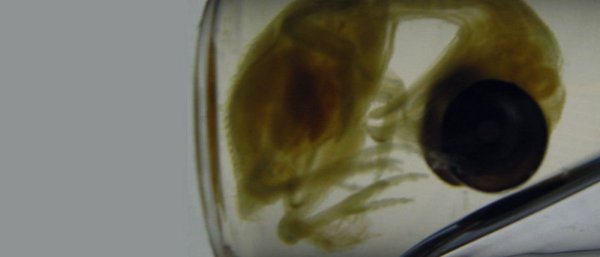
In a laboratory at the University of Chile, a chicken embryo developed a leg bone that harkens back to its ancient ancestors. For the second time, Brazilian researcher João Botelho has experimentally reversed a modern bird trait to a dinosaur-like condition, this time by blocking a maturation gene in the developing chick.
The work, published in the academic journal Evolution, focuses on the fibula, one of the two long bones in the lower leg. In living birds, this bone is a slender splinter that stops short of the ankle. But in theropod dinosaurs, the fibula was a robust tube that extended all the way down to the ankle joint. The new study shows that a single genetic tweak can restore that ancient shape in a chicken embryo.
How a Gene Shapes a Bone
Scientists have long known that bird embryos initially develop a tubular, dinosaur-like fibula. As development proceeds, the lower end of the bone matures early, ceasing growth and leaving the fibula shorter than its neighbor, the tibia. Botelho, working in the lab of Alexander Vargas, set out to understand what triggers that premature maturation.
In normal bone development, the shaft of a bone matures and stops growing long before the ends do. Botelho found that in the bird fibula, molecular signals at the lower end cause it to behave like a shaft, halting cell division and growth. By inhibiting a gene called Indian Hedgehog, he prevented that early maturation. The result: the fibula remained tubular and extended to the ankle, just as in dinosaurs.
The researchers propose that a nearby ankle bone, the calcaneum, plays a key role. In bird embryos, the calcaneum presses against the lower end of the fibula, sending signals that mimic those of the bone shaft. Normally, the calcaneum later detaches, but by then the fibula's fate is sealed. In the experimental chickens, the calcaneum remained attached, and the fibula retained its dinosaur-like form.
Beyond a Single Trait
This is not the first time Botelho has reversed a bird trait. Previously, he succeeded in undoing the evolution of the perching toe, producing a non-twisted, non-opposed toe similar to that of dinosaurs. These experiments are not aimed at creating living dinosaurs, but at testing specific hypotheses about how development evolved.
“The experiments are focused on single traits to test specific hypotheses,” Vargas said. “Not only do we know a great deal about bird development, but also about the dinosaur-bird transition, which is well-documented by the fossil record. This leads naturally to hypotheses on the evolution of development, that can be explored in the lab.”
The findings add a new layer to our understanding of how theropod dinosaurs evolved into modern birds. By pinpointing the genetic and developmental changes that shaped the bird skeleton, researchers can better interpret the fossil record and the mechanisms of evolutionary change.
For now, the work remains firmly in the realm of basic science. The researchers emphasize that their goal is not to resurrect prehistoric creatures, but to uncover the genetic underpinnings of a major evolutionary transition.
Leave a Comment
Comments (0)