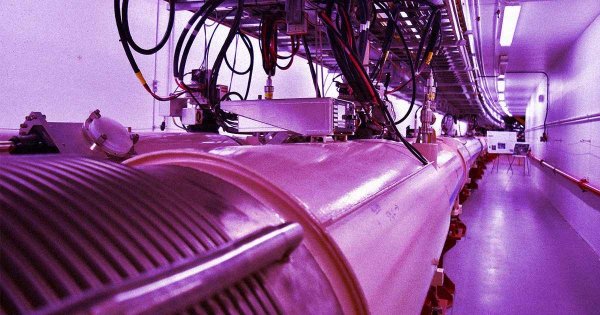
Long Island’s Brookhaven National Laboratory has been selected by the U.S. Department of Energy to host a major new research facility, the Electron-Ion Collider (EIC), a project that could cost up to $2.6 billion and is slated to begin operations in 2030. The announcement, made Thursday, positions New York as the home of a machine designed to probe the fundamental structure of matter.
The EIC will accelerate beams of electrons into protons and heavier atomic nuclei, allowing physicists to study the force that binds the building blocks of atoms. According to the Department of Energy, the collider will help answer long-standing questions about the nature of visible matter and the strong nuclear force that holds it together.
U.S. Secretary of Energy Dan Brouillette said in a press release that the facility “promises to keep America in the forefront of nuclear physics research and particle accelerator technology,” adding that it “will deepen our understanding of nature” and could lead to new technologies and innovations. The project is expected to cost between $1.6 billion and $2.6 billion, with construction likely to take several years before the collider becomes operational.
Brookhaven National Laboratory Director Doon Gibbs called the EIC “a new frontier in nuclear physics,” stating that it “will expand our knowledge of the fundamental constituents of the atoms that make up all visible matter in the universe today and the force that holds it all together.” The lab, located in Upton, New York, already operates the Relativistic Heavy Ion Collider, a predecessor that has been used for similar research.
Why the Location Matters
The selection of Brookhaven over a competing site in Virginia ends a multi-year review process. The Department of Energy’s choice reflects the lab’s existing infrastructure and expertise in accelerator physics, which are expected to reduce costs and accelerate the timeline. The project is seen as a significant investment in the region’s scientific community, potentially attracting researchers from around the world.
The EIC is part of a broader U.S. strategy to maintain leadership in nuclear physics, a field where European facilities like CERN’s Large Hadron Collider have drawn international attention. However, the EIC is designed to address different questions, focusing on the internal structure of protons and nuclei rather than discovering new particles.
While the collider’s construction is not expected to begin until after the design phase is complete, the announcement provides a clear direction for the field. Researchers anticipate that the EIC will generate a wealth of data, potentially leading to practical applications in areas such as materials science and medical imaging, though such outcomes remain speculative at this stage.
The project has been welcomed by New York officials and scientific organizations, who see it as a boost to the local economy and a testament to the state’s role in advanced research. The Department of Energy has not yet released a detailed construction timeline, but the 2030 target suggests a decade-long effort to bring the facility online.
As the EIC moves forward, it will join a small number of particle colliders worldwide, cementing Brookhaven’s status as a hub for nuclear physics. The facility is expected to support a wide range of experiments, from probing the spin of protons to exploring the behavior of quark-gluon plasma, a state of matter believed to have existed just after the Big Bang.
Leave a Comment
Comments (0)