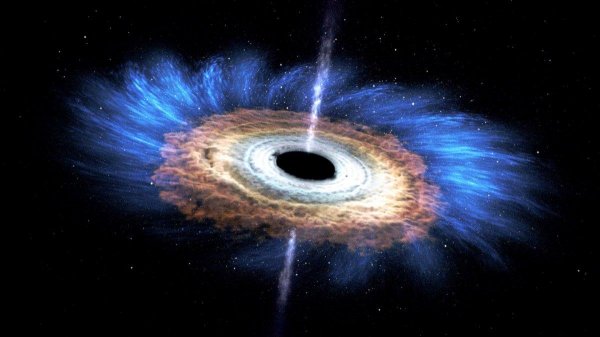
Astronomers in Japan have identified a strong candidate for an intermediate-mass black hole lurking within a turbulent gas cloud near the center of our galaxy. If confirmed, the object—estimated at 100,000 times the Sun's mass—would be the first of its kind detected in the Milky Way, ranking as the second-largest black hole in our galaxy after Sagittarius A*, the supermassive giant with 4 million times the Sun's mass.
The discovery, led by Tomoharu Oka of Keio University in Tokyo, emerged from observations of an elliptical cloud of gas roughly 150 trillion kilometers (93 trillion miles) across, located more than 200 light-years from Earth. The cloud's gases, including carbon monoxide and hydrogen cyanide, were found to be moving at wildly different velocities—a pattern that puzzled researchers and prompted them to train the Atacama Large Millimeter/submillimeter Array (ALMA) in Chile's Atacama Desert on the region.
What they found was evidence of immense gravitational forces at play. Using computer models, the team deduced that the most plausible explanation is a black hole no larger than 1.4 trillion kilometers (870 billion miles) in diameter. Adding to the case, they detected extremely strong radio waves emanating from the cloud's center—a signature consistent with a black hole's presence, since black holes themselves emit no light, but their gravitational pull can accelerate surrounding matter, producing detectable radiation.
This potential discovery fills a critical gap in our understanding of black hole formation. Until now, astronomers have only observed black holes at the extremes: stellar-mass black holes, which form when massive stars explode as supernovae, and supermassive black holes like Sagittarius A*, which typically anchor the centers of large galaxies. The intermediate range—between a few solar masses and millions—has remained elusive, leaving scientists with a puzzle akin to a city populated only by children and the elderly, with no adults in between.
While only about 60 stellar-mass black holes have been confirmed in the Milky Way, scientists estimate that up to 100 million may exist. The origin of supermassive black holes, however, remains a mystery. One leading theory suggests that smaller black holes merge and migrate toward galactic centers, growing ever larger. But if that process occurs, the universe should be teeming with mid-size black holes—yet none had been found until this candidate.
Clues to a Galactic Past
Oka's research, published in the journal Nature, offers a possible origin story: the black hole could be the remnant of a dwarf galaxy that was consumed by the Milky Way billions of years ago. If so, this object may not only represent a missing link in black hole evolution but also a snapshot of galactic cannibalism.
The findings also hint at a future event. Oka explained to The Guardian that the black hole is likely destined to spiral inward toward Sagittarius A*, eventually being swallowed by the supermassive black hole at our galaxy's heart, adding to its mass. That process, however, would unfold over an immense timescale, far beyond human observation.
For now, the candidate awaits further verification. But if confirmed, it would mark a significant milestone in astrophysics, providing the first direct evidence that intermediate-mass black holes exist in our own galactic neighborhood.
Leave a Comment
Comments (0)